
Understanding the PPR Fitting System
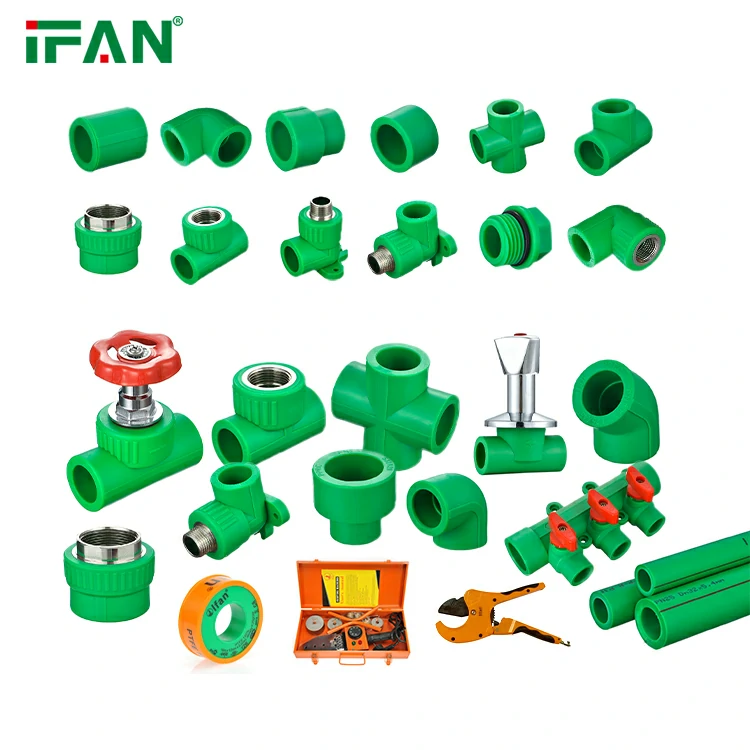
PPR fittings form a complete plumbing system. They are made from the same material as PPR pipe. This ensures perfect compatibility and fusion. The system is designed for heat-fusion welding. It creates a monolithic, leak-proof network. Fittings are categorized by their function and shape.
Elbows for Changing Direction
Elbows are among the most common types. They allow pipes to change direction. Standard angles are 90 degrees and 45 degrees. A 90-degree elbow creates a right-angle turn. A 45-degree elbow makes a gentler bend. These are essential for navigating building layouts.
Tees for Branching Connections
Tee fittings create branch lines. They have one inlet and two outlets. The outlets are typically at 90 degrees. Equal tees have all three openings the same size. Reducing tees have a smaller branch outlet. They connect fixtures like sinks to main lines.
Couplings for Straight Connections
Couplings join two pipes in a straight line. They are used to extend a pipe run. A full-diameter coupling is most common. It maintains the internal bore size. This prevents any flow restriction. They are simple but vital components.
Reducers for Transitioning Pipe Sizes
Reducers connect pipes of different diameters. They ensure a smooth transition. Concentric reducers are aligned on a central axis. Eccentric reducers have an offset centerline. This helps maintain a level pipe run. They are used where system size changes.
End Caps and Plugs for Termination
End caps seal the end of a pipe. They are used to terminate a line permanently. Plugs seal the end of a fitting. They are often used for future connections. Both provide a secure, pressure-rated closure. They are tested during system pressure checks.
Adaptors for Connecting to Other Systems
Adaptors interface PPR with other materials. A male adaptor has external threads. A female adaptor has internal threads. They connect to copper, steel, or brass systems. Some have a union connection for disassembly. They are crucial for system integration.
Balls Valves for Flow Control
PPR ball valves are integral to the system. They allow manual shut-off of water flow. They use a fused PPR body with a brass ball. The handle operates a quarter-turn mechanism. They are installed for maintenance isolation. They come in various diameters.
Pipe Clips and Support Fittings
These are not flow fittings but are essential. PPR pipe clips support the pipe. They prevent sagging in long horizontal runs. They allow for thermal expansion movement. Correct spacing is critical for system integrity. They are part of a complete installation.
Manifolds for Distribution
Manifolds centralize distribution. A domestic hot water manifold is an example. One large inlet feeds several smaller outlets. This allows balanced flow to multiple fixtures. It simplifies system design and control. It is common in modern home plumbing.
Sockets and Union Fittings
Sockets are used for direct pipe insertion. Union fittings allow for future disassembly. They consist of a nut, a socket, and a union ring. This is useful for connecting to appliances. It allows for service without cutting the pipe. They offer flexibility.
Conclusion on Fitting Variety
In summary, many PPR fittings are available. Each serves a precise hydraulic or structural purpose. The range includes elbows, tees, reducers, and valves. Adaptors connect to other piping materials. A complete system uses all these types. Proper selection ensures an efficient, reliable plumbing installation.