
A Material with High Thermal Responsiveness
PPR is a thermoplastic with a high coefficient of expansion. This means it changes size significantly with temperature. It can expand up to ten times more than metal pipes . Understanding this is critical for proper system design .
The Exact Coefficient of Expansion
The industry standard coefficient for PPR is α = 0.15 mm/m·K . A simpler way to express this is 1.5 x 10⁻⁴ K⁻¹ . This value is the amount of expansion per meter of pipe for each degree of temperature change . Plastic PPR Pipe Fittings and pipes share this physical property.
Calculating the Expansion Rate
The basic formula is very straightforward. You multiply the pipe length by the temperature change and the coefficient. For example, a 10-meter pipe heated by 40°C will expand by 60 mm . This is calculated as 0.15 mm/m·K × 10 m × 40 K = 60 mm.
Practical Examples of Expansion
Consider a straight pipe run of 15 meters. A temperature rise of 50°C causes expansion of 120 mm . This movement is substantial and must be accommodated. If the pipe is rigidly fixed at both ends, internal stress builds up very quickly.
The High Force Generated by Restrained Pipes
If the expanding pipe is completely blocked, stress develops quickly. This stress is calculated using the modulus of elasticity. At a 70°C rise, the stress can reach 9.52 MPa . This is 85% of the material’s yield strength. This force often causes Plastic PPR Pipe Fittings to crack or leak.
Comparing Different PPR Types
Not all polypropylene pipes expand at the same rate. Standard PP-R is the highest at 0.15 mm/m·K . Fiber-reinforced PP-R (PPR-FIBER / α = 0.088 mm/m·K) has almost half the expansion . Aluminum composite PPR (PPR-Al / α = 0.03 mm/m·K) is the most stable . Modern composite pipe (PPR-GF / α = 0.05 mm/m·K) offers strong performance .
Designing for Passive Compensation
You can allow the pipe to move freely using natural bends. Directional changes create expansion arms (L-shapes) . The length of the expansion arm is calculated as Lb = 30 × sqrt(d × ΔL) for PPR . This is a passive method that does not require mechanical parts. It works best when space is available.
Using Expansion Loops (U-Bends)
When no natural bends are present, create an expansion loop. The width is calculated as Lc = 2 × ΔL + 150 mm . This allows the pipe to “breathe” safely between fixed points .
The Critical Role of Fixed and Sliding Supports
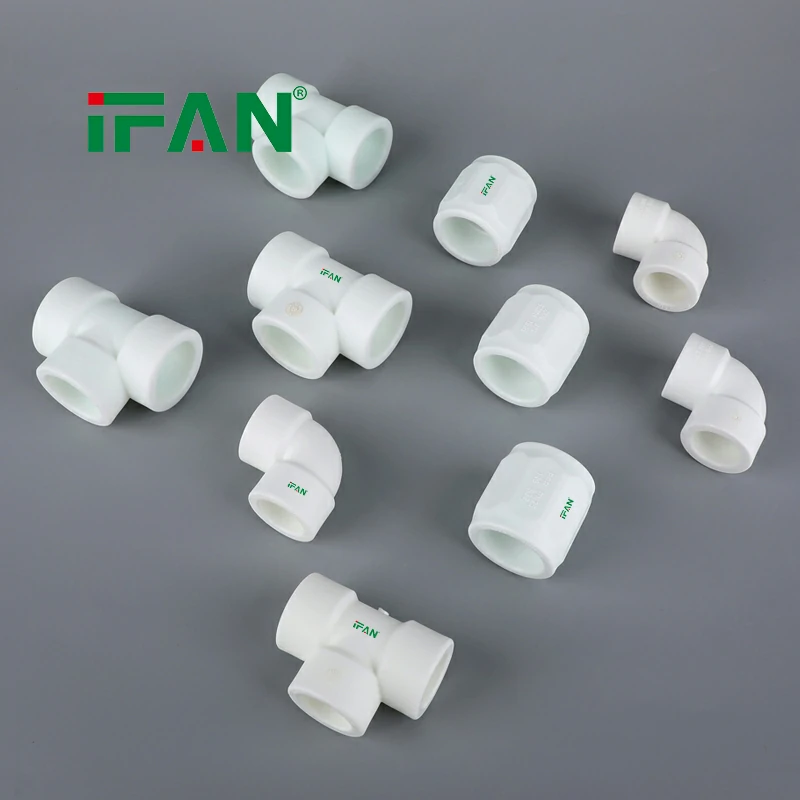
Proper supports are essential for system function. Fixed points are placed near branches, valves, or walls . Sliding points are placed along the route to permit axial movement . Without sliding points, the force of expansion would stress the Plastic PPR Pipe Fittings at the joints.
Solutions for Buried or Embedded Pipes
When pipes are in walls or screed, they cannot move freely. They must be installed in a protective sleeve . The sleeve must be flexible and able to absorb movement . The depth must be at least 1.5 times the pipe’s diameter . Threaded joints are not permitted inside walls for this reason .
Special Climate and Environmental Factors
Climate plays a significant role in design requirements. Tropical regions require an extra 20% expansion margin . Sun-exposed roof runs need +15°C adjustment for ambient heat . Below-freezing climates require accounting for 35% contraction . Middle Eastern installations need 30% more compensation than temperate zones .
Conclusion on Thermal Behavior
Plastic PPR Pipe Fittings do expand and contract significantly. This is a normal physical property of the polymer . You must not ignore this movement during installation . Use expansion loops, direction changes, or sliding supports. For concealed work, protective sleeves are mandatory . With proper planning, you control the expansion. This prevents stress on your systems and guarantees a long service life .