
Important Safety Disclaimer
Manufacturers and international standards generally do not recommend standard PPR for compressed air systems . Compressed air and water behave fundamentally differently. Unlike water, which is incompressible and typically leaks when a pipe fails, compressed air stores significant potential energy that can be released violently during a rupture .
This guide acknowledges that some installations proceed regardless of warnings. However, using approved materials like aluminum or steel should always be prioritized for safety and code compliance .
The Fundamental Risk: Rapid Crack Propagation (RCP)
Standard PPR can suffer from a failure mode called Rapid Crack Propagation . During RCP, a fracture travels through the material at hundreds of meters per second. The pipe can shatter into sharp, high-velocity fragments .
This fragmentation creates a dangerous projectile hazard . Approved metal materials like aluminum and steel typically fail differently: they tear or “fish-mouth” locally, releasing pressure without fragmenting . Plastic PPR Pipe Fittings used in compressed air service require careful risk assessment.
Pressure and Temperature De-Rating
PN ratings (e.g., PN16, PN20) are established for cold water service at 20°C (68°F) . Compressed air systems present different operating conditions.
Compressors generate significant heat. The air temperature at the system outlet can be high, especially before aftercoolers . Pressure capacity decreases as temperature rises.
At 60°C (140°F), a standard PPR pipe might derate to roughly 50% of its rated capacity . If your air temperature exceeds 40°C (104°F), you must derate the pipe’s pressure rating by at least 20% . Failure to apply proper temperature derating is a leading cause of system failure .
Material Variations: PP-R vs. PP-RCT vs. PPRC
The specific polypropylene grade significantly impacts performance. Standard PP-R is generally not recommended for compressed air . However, advanced grades exist.
PP-RCT (Polypropylene Random Crystallinity Temperature) has a modified molecular structure. It maintains pressure capacity much better at elevated temperatures that would weaken standard PPR .
PPRC (Polypropylene Random Copolymer) is another term for this material. Some industrial systems, like the GreenFit Blue system, are specifically formulated for pneumatic applications and can withstand temperatures from 0°C to 95°C .
As a result, certain specialized Plastic PPR Pipe Fittings are explicitly marketed for compressed air lines, particularly in industrial settings .
The Issue of Threaded Connections
Threaded plastic fittings are a specific point of failure. A safety alert from an Australian mine described a fitting that “blew out” of a compressed air line .
The investigation found that: (1) the fitting was under-rated for the operating pressure, and (2) the threaded joints were not tightened correctly or sealed properly .
Threaded Plastic PPR Pipe Fittings are subject to stress risers at the root of the threads. If you must use them, you must follow strict assembly instructions and use proper thread sealant .
Oil Compatibility Concerns
Many industrial rotary screw compressors use synthetic lubricants. Some of these compressor oils can attack the molecular structure of PPR over time . This chemical attack makes the pipe brittle and prone to sudden rupture without visible warning. Always verify the chemical compatibility of your specific pipe grade with your compressor’s lubricant. Aluminum pipes do not react with standard compressor oils .
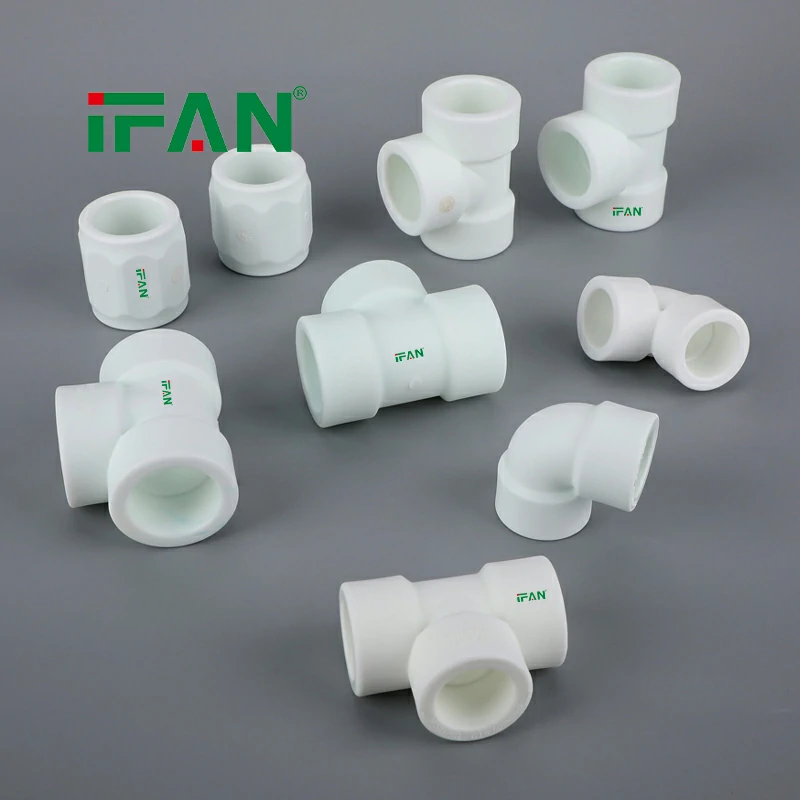
Heat-Fusion Joining for Leak Prevention
The primary advantage of PPR in any application is heat-fusion welding. This process creates a monolithic, homogeneous joint . The pipe and fitting material fuse into a single piece, eliminating the potential leak paths inherent in threaded or mechanical connections .
For compressed air applications where leaks are costly, this jointing method provides high reliability. However, the fusion process must follow precise time and temperature parameters to ensure joint strength .
Support and Thermal Expansion Management
PPR expands significantly more than metal when heated. A 30-meter run can expand several inches when the pipe warms up .
This movement can shear poorly supported fittings. Plastic PPR Pipe Fittings require supports every 2-4 feet (approximately 600-1200mm) .
Long straight runs must include expansion loops or offsets to absorb the length changes from temperature variations .
Applications Where PPR Is Used Successfully
Despite the risks, there are documented cases of successful PPR compressed air systems.
- Microbrewery in France: The NIRON PPR system was installed for the compressed air network, valued for the safety and durability of polyfusion welding .
- Pharmaceutical and Electronics Facilities: PPR is used in clean-air environments requiring oil-free air and moderate pressure .
- Industrial Pneumatic Controls: Systems like GreenFit Blue are marketed specifically for compressed air and vacuum lines in manufacturing .
Design Considerations for Safety
If you proceed with PPR, specific design rules apply. Use a looped distribution system to maintain consistent pressure and provide redundancy . Design the layout to minimize directional changes, using swept bends instead of sharp elbows .
Main headers should slope 1-2% toward drainage points to allow condensate to drain away from the system . Water accumulation degrades air quality and can cause system issues.
Maintenance and Inspection Protocols
PPR systems used outside of their intended specifications require rigorous safety monitoring .
- Monthly Visual Checks: Inspect fusion joints for stress-whitening or cracking, and check pipe surfaces for damage .
- Leak Detection Surveys: Use ultrasonic detectors quarterly to find leaks that might indicate material degradation .
- Emergency Planning: Operators must have procedures for rapid system isolation in case of a rupture .
Ongoing maintenance cannot eliminate the fundamental safety concerns associated with using an unapproved material, but it can help manage risk .
Conclusion: Weighing the Risks and Benefits
Plastic PPR Pipe Fittings can be physically used for compressed air, but this application is not universally safe or code-compliant . Regular PPR is unsuitable due to the risk of shattering . However, specific high-grade, PP-RCT materials are manufactured for this purpose .
If you choose to use PPR, you must: use high-pressure grades (PN20 or PN25), account for temperature de-rating, use heat-fusion (not threaded) joints, provide close support spacing with expansion management, and verify chemical compatibility with compressor oils .
For high-pressure systems, outdoor environments, or safety-critical applications, approved materials such as aluminum (which tears instead of shattering) or stainless steel remain the professional standard . Always check your local pressure equipment codes before installation.
I hope this technical deep dive helps you make an informed decision. Are you designing a system for a specific industrial setting, such as a workshop or a manufacturing plant? Knowing the application can help narrow down the safest material choice.