
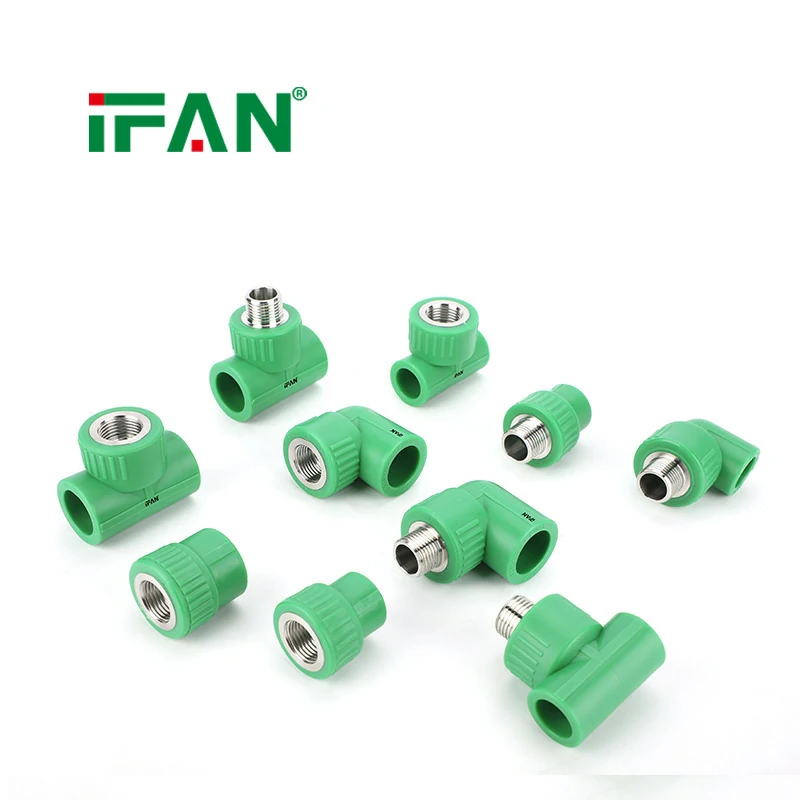
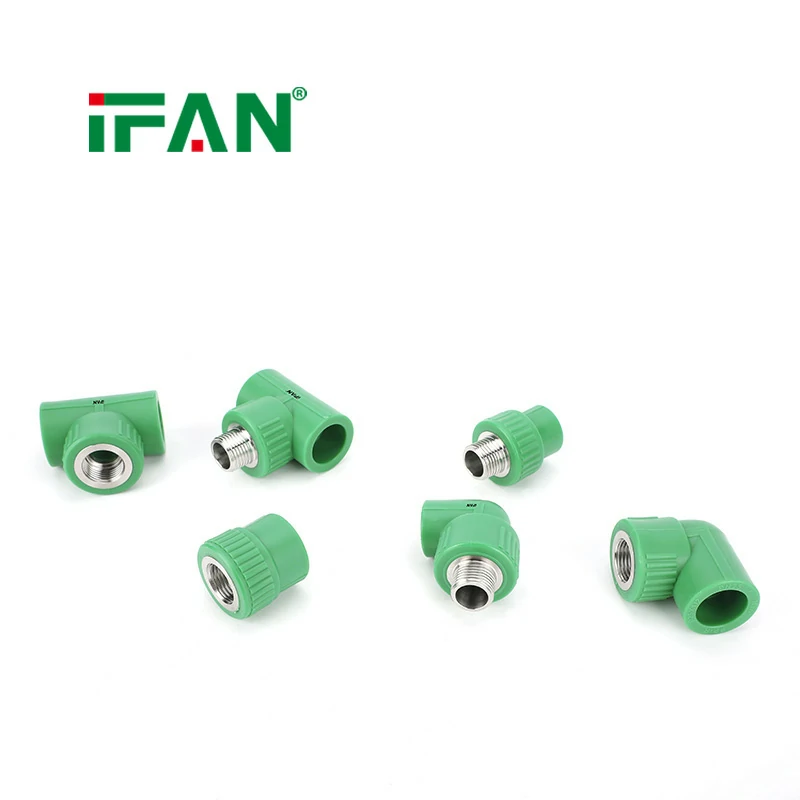
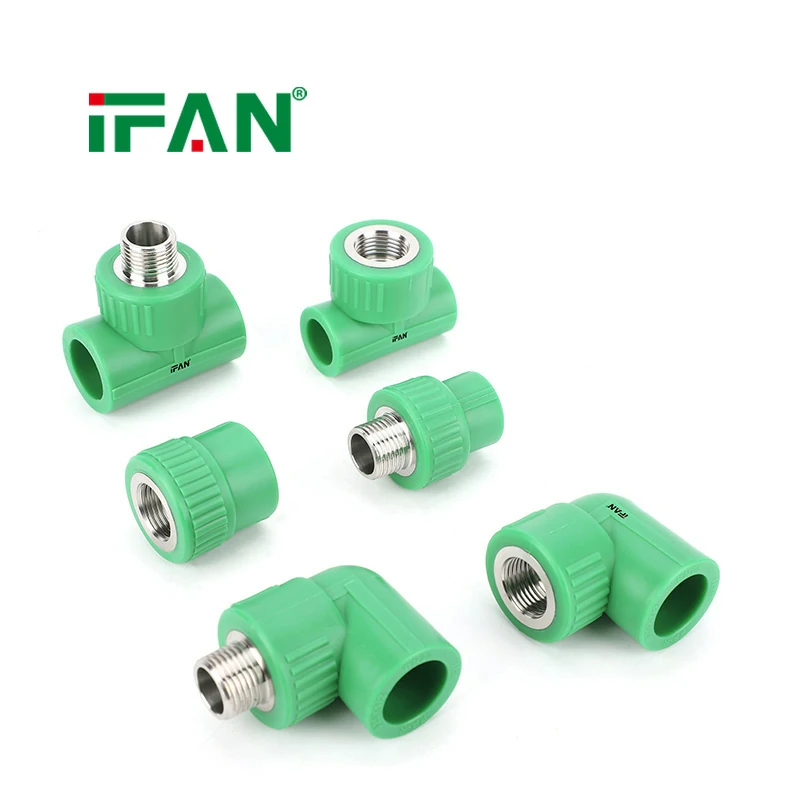
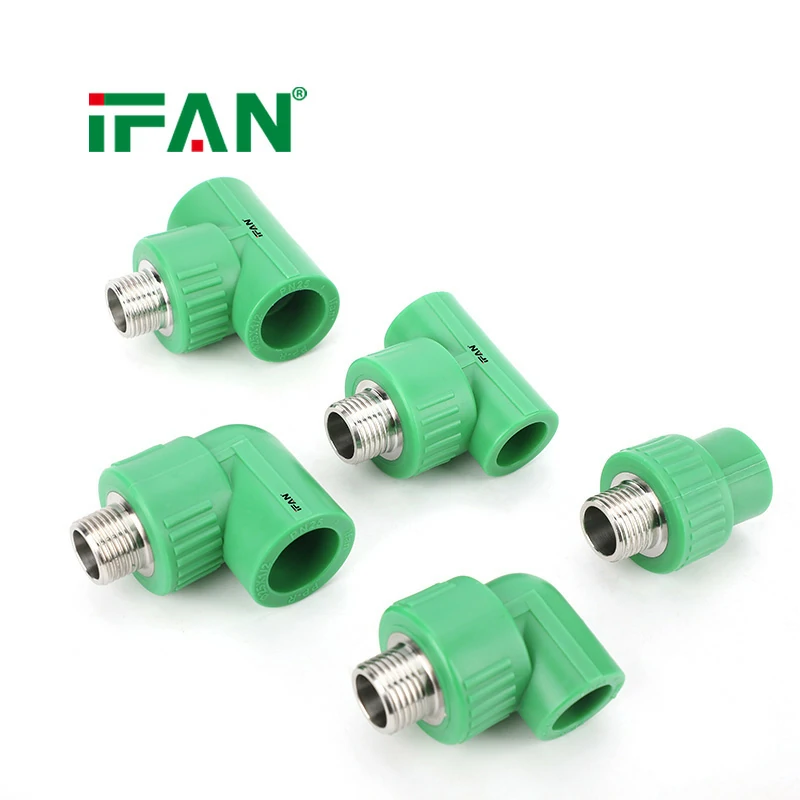
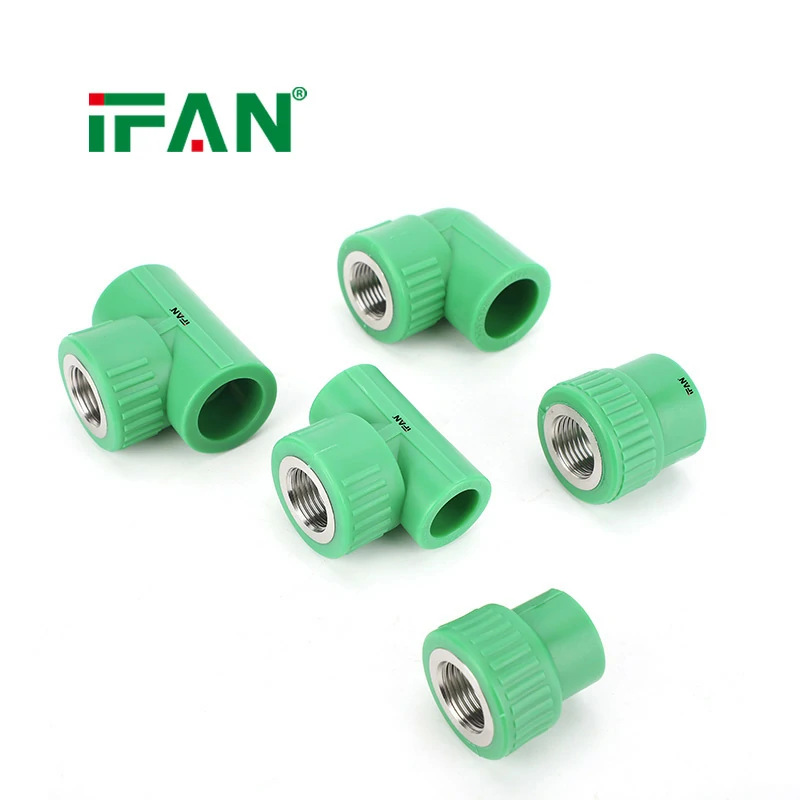
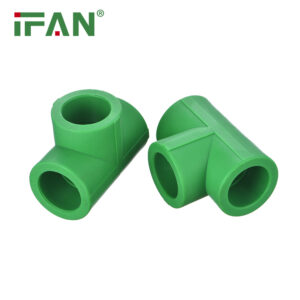
IFAN Green Stainless Steel PPR Fittings
Name: IFAN Stainless Steel PPR Fittings
Brand: IFAN
Category : Click Download
Whatsapp : +86 19884503412</p>
Category : Click Download
Whatsapp : +86 19884503412
Wechat : 19884503412
Description
The term “stainless steel PPR fittings” refers to PPR (Polypropylene Random Copolymer) fittings that incorporate stainless steel components, typically in the form of threaded inserts or reinforcing elements . Piping systems often require connections to metal pipes, valves, or equipment. PPR is a plastic material ideal for water transport, but it cannot be directly threaded or welded to metal.
Stainless steel PPR fittings solve this incompatibility by fusing a metal part into the plastic body, creating a robust and leak-proof connection point .
The Design and Construction
A stainless steel PPR fitting is not made entirely of steel; rather, it is a hybrid component. It consists of a main body made of PPR plastic, with a stainless steel (typically AISI 304 or 316) insert permanently embedded in the socket end .
This stainless steel part provides the standardized internal (female) or external (male) threads necessary to screw the fitting onto a metal pipe, radiator valve, pump, or water heater .
The two materials are joined during the manufacturing process. The stainless steel insert is placed into an injection mold, and molten PPR is injected around it . As the plastic cools, it shrinks and creates a molecular bond with the metal, forming a single, inseparable unit .
What They Are Used For
Transition Connections: Their primary purpose is to act as a transition between a PPR piping system and a metal one . You would use a stainless steel PPR fitting to connect a PPR pipe to a brass gate valve, a steel radiator, a copper boiler connection, or a threaded water meter.
Heating Systems: These fittings are the industry standard for connecting PPR pipes to radiators, boilers, and circulation pumps . The stainless steel thread provides the vibration-resistant mechanical connection needed, while the PPR body resists corrosion from hot water.
Aggressive Environments: When the fluid is highly corrosive, or the environment is marine or chemical, stainless steel (316 grade) is chosen over standard brass inserts . While brass handles most water, stainless steel offers superior resistance to dezincification and chemical attack, ensuring a longer service life in demanding applications .
Stainless Steel PPR Fittings vs. Brass PPR Fittings
Most PPR transition fittings use brass inserts because they are cost-effective and work well for standard potable water . However, stainless steel PPR fittings are the preferred choice in specific scenarios :
| Feature | Stainless Steel PPR Fittings | Brass PPR Fittings |
|---|---|---|
| Corrosion Resistance | Excellent; ideal for aggressive water, chlorides, and marine environments . | Good; but vulnerable to dezincification (zinc leaching) in hot or aggressive water . |
| Material Cost | Higher . | Lower . |
| Strength | Higher mechanical strength; resists high pressure and torque . | Strong but softer than stainless steel. |
| Best Use Case | Chemical plants, industrial applications, high-purity systems, coastal installations . | General residential plumbing, heating systems with treated water . |
| Pressure Rating | Can handle very high pressures (e.g., up to 250 PSI or more depending on grade) . | Typical ratings of 150-300 PSI for water and gas . |
Key Advantages and Features
Leak-Proof Connection: Because the stainless steel thread is permanently fused into the PPR body, it cannot spin or loosen over time . This is crucial for connections to pumps that vibrate during operation.
Durability: The combination of PPR’s resistance to scale and corrosion and stainless steel’s mechanical strength creates a fitting with an exceptionally long lifespan, often exceeding 50 years .
Temperature Resistance: These fittings can typically handle continuous operating temperatures up to 95°C, making them suitable for hot water and heating systems .
Compliance: High-quality stainless steel PPR fittings are certified for potable water (NSF/ANSI 61) and meet international pressure standards (e.g., DIN PN25) .
Installation
Installation is identical to standard PPR fittings and does not require special tools for the metal part. The PPR side is joined to the plastic pipe using a heat fusion (socket welding) tool . The stainless steel threaded side is then screwed onto the metal component using a wrench. No soldering or threading of the plastic pipe is required .
Summary
In summary, a stainless steel PPR fitting is a high-performance transition fitting designed to connect a PPR plastic pipe to a metal system. It is the optimal choice for applications involving aggressive fluids, high temperatures, high pressures, or where the superior corrosion resistance of stainless steel over brass is required for long-term reliability .
相关产品
 Green PPR Pipe Fittings
PPR Socket Fitting
- Green PPR Pipe Fittings
PPR Tail Elbow
- Green PPR Pipe Fittings
PPR Reduce Elbow
- Green PPR Pipe Fittings
PPR Tee Fittings



HAVE ANY QUERIES? SEND TO CONTACTOANTSMACHINE.COM
ONTACT US